
The Invisible £380K: What You Can’t See Across Your Estate Is Costing You Without Multi-Site Operations Monitoring
- Ross Palmer

- Apr 29
- 4 min read
Updated: Apr 30
A typical 200-site retail estate is losing over £380,000 a year, not from major outages, but from problems nobody sees in time. Without effective multi-site operations monitoring, these issues go unnoticed until they have already impacted revenue, customers, and cost.
Not the big failures that trigger alarms.
Instead, the loss shows up elsewhere, slower tills on a Saturday afternoon, engineer call-outs that could have been avoided, customers abandoning queues, and not returning.
This is the invisible cost of IT. And for most multi-site operators, it is happening right now.
If you want to see what that number looks like across your own estate,

Outages aren’t the issue. Visibility is.
At first glance, most organisations appear to have control. Dashboards are in place. Tickets are being raised. Reports are being produced.
However, across multi-site operations, the reality is very different.
Issues rarely begin as failures; they begin as degradation.
Transactions are slow without triggering alerts
Performance drops during peak trading.
Small issues compound into measurable revenue loss
Without full visibility into the retail estate, these problems are not identified early. And that is exactly where the cost begins to build.
Where the £380K actually goes
To understand where that £380K goes, you have to look at how these issues actually play out across the estate.
The loss is not caused by a single major failure. Instead, it spreads across three consistent patterns.
1. Issues sit undetected for weeks
This is where the problem starts.
Across large estates, faults go unnoticed for an average of 23 days.
Not because teams lack capability, but because they lack a complete view across every site.
And crucially, most issues don’t start as failures; they start as a gradual decline.
A system slows slightly.
A payment process takes longer than it should
A connection becomes unstable during peak hours
At this stage, nothing breaks, so nothing is escalated.
This is how many well-known retail incidents begin. Payment disruptions rarely appear instantly; instead, they build over time and only become visible once customers are already being affected.
By the time the issue is recognised centrally, stores may have been operating below optimal performance for hours, sometimes days or even weeks.
As a result, the commercial impact builds quietly:
Slower transactions
Reduced customer throughput
Lost peak-hour revenue
Across hundreds of sites, what looks like a minor issue becomes a measurable loss.
2. The business spots problems before IT does
When those issues finally surface, they are rarely picked up by IT first.
In fact, in 68% of incidents, issues are identified by store staff.
By that point, the customer has already felt the impact.
The pattern is consistent:
Systems slow down
Staff notice queues building
A call is made to IT
A ticket is raised
Investigation begins
At this point, the operating model has already shifted to reactive.
And that carries a direct commercial cost:
Customers leave before completing purchases
Store teams lose time managing issues
Customer experience scores decline
Without effective multi-site IT monitoring, the business itself becomes the detection layer.
And by then, the damage is already done.
3. Reactive call-outs quietly drive up cost
Once operations become reactive, cost follows quickly.
When visibility is limited, every issue becomes a response event, and that leads directly to higher reactive call-out costs.
Typical impact across estates:
More engineer dispatches
Incorrect first-time fixes
Repeat site visits
Longer resolution times
A single avoidable call-out typically costs £800–£1,500.
Across a 200-site estate, this builds quickly into a six-figure annual spend, often exceeding £380K without being clearly tracked.
Rather than appearing as a single line item, it shows up as a rising operational cost with no clear explanation.
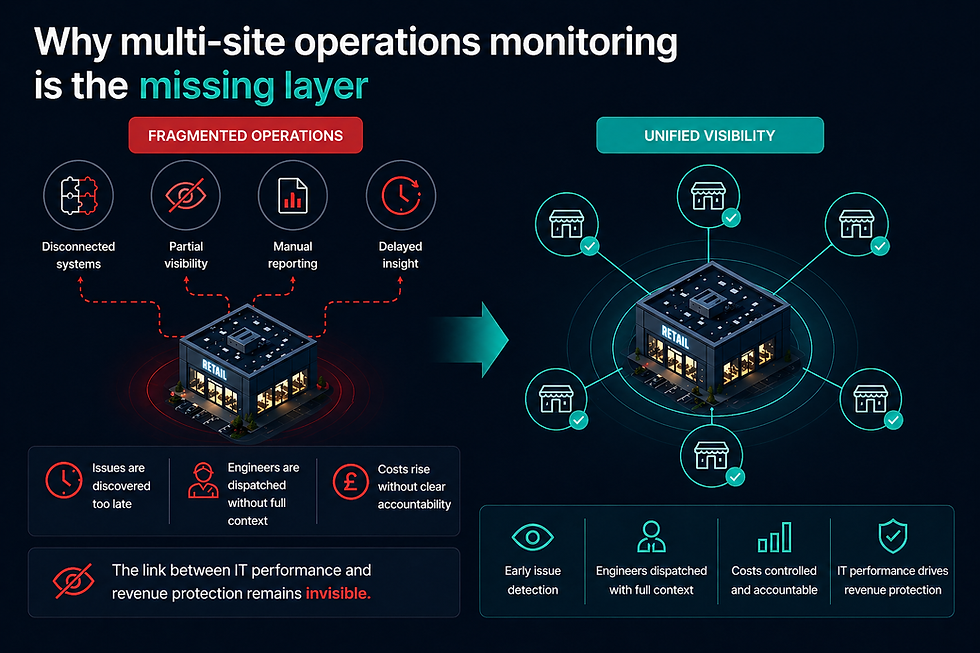
Why multi-site operations monitoring is the missing layer
So why does this continue to happen?
Most organisations already have tools in place, monitoring systems, ticketing platforms, and reporting processes.
But they lack a single, unified view across the estate, often described as a “single pane of glass”.
Instead, they operate with:
Disconnected systems
Partial visibility
Manual reporting
Delayed insight
This is the difference between having tools and having true multi-site operations monitoring.
Without it:
Issues are discovered too late
Engineers are dispatched without full context
Costs rise without clear accountability
And critically, the link between IT performance and revenue protection remains invisible.
A real-world scenario: peak trading loss
To see how this plays out in practice, consider a convenience retail estate during peak hours.
At several sites:
Systems are running significantly slower than normal
Payment failures are increasing
Performance has been degrading for days
From a central view, nothing appears broken.
However, on the ground:
Queues build
Transactions slow
Customers walk away
This is a multi-site trading outage in slow motion.
No single failure. No clear alert.
But measurable revenue loss across the estate.
What good looks like
The good news is that this is fixable.
When visibility improves, the operating model changes quickly.
Issues are identified before they impact sites
A single operational view replaces fragmented systems
Engineers are dispatched with the right information first time
Reporting becomes real-time and board-ready
This is what effective multi-site operations monitoring should deliver, not just data, but clarity.
It comes from connecting what is happening across every site into a single, real-time operational view that the business can act on.
From reactive to in control
The difference between reactive operations and controlled operations is not more people or more tools.
It is visibility.
When you can see what is happening across every site:
Issues are caught earlier
Response becomes faster and more accurate
Costs become visible and reducible
At that point, operations shift from firefighting to control.
See what’s really happening across your retail estate
The question then becomes: how do you actually see what’s happening?
Most operators do not need another report.
They need to see what is actually happening across real sites, in real time.
Estate Health Snapshot (EHS)
A live, two-week view of what is really happening across your estate.
Visibility across 3–5 live sites
Hidden issues uncovered in days, not months
Clear, board-ready view of cost, performance and risk within 14 days
No disruption to operations
No cost, no commitment
Most estates do not have a resilience problem. They have a visibility problem.
And that gap is where the £380K is hiding. Until you can see it, you cannot reduce it.
OpSite AI — See Every Site. Act on Every Signal.


Comments